


Hey everyone, if you're here because you're growing or selling Blue Fuji Peonies, you've probably already realized that getting their container size right is half the battle (wait, no-actually, it's the key to happy plants that bloom their heads off!). I've been a peony supplier for over 10 years, and let me tell you, one of the most common questions I get from new growers, landscapers, and even home gardeners is, "What size container do I need for Blue Fuji Peony?" I've messed up a lot along the way-like that time I put 3 Blue Fuji bare roots in 12-inch pots and they barely grew, let alone bloomed. So today, I'm breaking down exactly what size works, why it matters, and how this ties to other peony varieties I sell too. Stick around, because this info's gonna save you from the same mistakes I made.
First, let's do a quick refresher on Blue Fuji Peony itself-if you're not familiar, it's that stunning ruffled, pale blue-lavender herbaceous peony that's become a fan favorite for cut flower arrangements and garden beds. I've linked the full details here for anyone new to it: Blue Fuji Peony. What makes Blue Fuji different from, say, Hawaiian Coral Pink Peony or Coral Sunset Peony (check those links too, they're gorgeous) is its root structure. Peonies aren't like tiny annuals that you can cram into a 6-inch pot. They're perennials with thick, fleshy roots that spread and need room to breathe, store energy, and send up those big, heavy stems and blooms.
Let's start with the basics: why container size isn't arbitrary. If your Blue Fuji is in a pot that's too small, here's what happens. First, the roots will become root-bound-they'll wrap around the bottom of the pot, get tangled, and can't take up water or nutrients properly. That means stunted growth, fewer blooms, and the plant might even die after a year or two. Second, peony stems get tall-Blue Fuji can hit 2-3 feet tall when mature-so a small pot can't anchor the plant, and it'll tip over when there's wind or when those blooms are heavy with rain. Third, peonies need consistent moisture, but too small a pot dries out way too fast, especially in hot weather, which stresses the plant. I learned this the hard way with Duchess Peonies too-same root logic applies, even if their blooms are different shapes-so trust me on this.
Now, let's get to the numbers, because that's what everyone's here for. First, I'm talking about both bare root peonies (the ones we ship to most customers) and potted peonies (for people who want instant blooms). For bare root Blue Fuji Peony-our most popular order right now-here's my rule of thumb: start with a 1-gallon pot if you're planning to transplant it outdoors after one season, but if you're keeping it in a container permanently, you need to step up to at least a 5-gallon pot. Wait, hold on-let me clarify that. A 1-gallon pot is fine for a year of growth to get it established, but if you leave it there past that, it's gonna be sad. A 5-gallon pot is the sweet spot for a single, mature Blue Fuji Peony. Why? The 5-gallon size gives the roots enough space to spread out (about 12 inches of depth and diameter, roughly) so they don't get bound, and it's heavy enough to keep the tall stems from tipping. I've tested this with my own stock: plants in 5-gallon pots bloom 2-3 times more than those in 3-gallon ones, and they look way healthier.
What if you want to plant more than one Blue Fuji in a container? Let's say you're making a big patio display. Don't do more than two in a 15-gallon pot. Any more than that, and they'll compete for nutrients, and none of them will bloom well. I tried three in a 10-gallon pot once-total flop. Compare that to Red Charm Peony, which is a bit smaller, so you could fit three in a 15-gallon pot, but Blue Fuji's roots are more vigorous, so they need more space. That's why checking each variety's needs matters, not just guessing based on general peony rules.
Wait, what about if you're growing Blue Fuji in a really big pot, like a 20-gallon one? Is that overkill? No, actually-if you have the space, go for it. I have a few 20-gallon pots on my supplier's patio that have Blue Fuji and Hawaiian Coral Pink Peony side by side, and both thrive. The only downside is moving them if you need to, but most people who grow peonies in large pots leave them in place for years anyway. The key is that the pot has drainage holes-non-negotiable. Peonies hate sitting in wet soil, so even a perfect size won't help if water just pools at the bottom. I always drill extra holes in the bottom of any pot I use for peonies, just to be safe.
Let's talk about soil too, because container size pairs with soil quality. If you have a huge pot but use cheap, compacted soil, the roots still can't grow. For Blue Fuji, I use a mix of regular potting soil, compost, and perlite-about 2 parts potting soil, 1 part compost, 1 part perlite. That mix drains well but holds enough nutrients. I've seen customers use straight potting soil and their peonies do okay, but the ones that mix in compost bloom way better. Another tip: don't pack the soil too tight when you plant the bare root Blue Fuji. The crown (the part where the roots meet the stems) should be about 1-2 inches below the soil surface-if it's too deep, no blooms, too shallow, it might freeze in winter. That's a common mistake, even when you get the container size right.

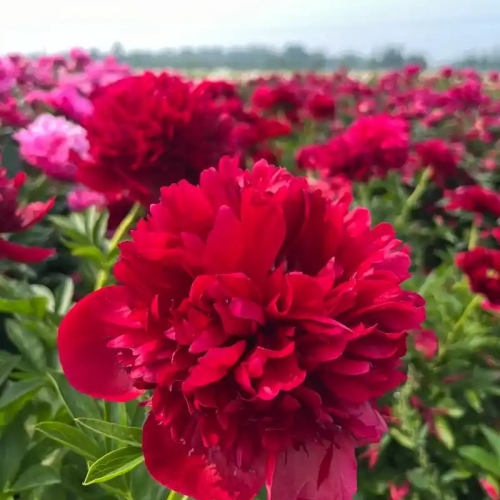
Let's compare Blue Fuji to other peony varieties to make sure this isn't just my opinion. Let's take Coral Sunset Peony-it's a bit shorter, so a 3-gallon pot works for one mature plant, right? Yeah, I sell a lot of those for patio planters. Duchess Peony is similar in size to Coral Sunset, so same container needs. Red Charm Peony is a mid-sized peony, so 5 gallons for one, same as Blue Fuji, but Blue Fuji's roots are just a hair more vigorous, so I still lean a bit more towards 5 gallons for Blue Fuji over 3 gallons for Red Charm. That's why knowing your specific variety is key-just because they're all peonies doesn't mean their container needs are identical.
Wait, what about home gardeners vs. commercial suppliers? I mentioned I'm a supplier, so I deal with both. For home gardeners who might not have a huge outdoor space, a 5-gallon pot is manageable-you can move it if there's a bad frost, or if you want to rearrange your patio. For landscapers using Blue Fuji in large planters for events, a 15-gallon pot with two plants works great for that instant, dramatic display. I also supply bare root Blue Fuji to people who want to plant them outdoors-those just need a hole that's 12-18 inches deep, which is way bigger than any container, but that's a different scenario. Today's whole question is about containers, so we're sticking to potted growth.
Let me answer a few common questions I get about this. First, can I grow Blue Fuji in a smaller pot if I repot it every year? Technically, yes, but it's more work, and the plant will be stressed. Repotting peonies every year is a hassle, and you risk damaging the roots when you pull them out. It's way easier to start with a 5-gallon pot and leave it there for 3-5 years before you need to repot. I only recommend annual repotting for people who really don't have space for a 5-gallon pot, and even then, go as big as you can for the first year.
Second, why does container size matter so much for blooming? Peonies are heavy feeders, and they store energy in their roots. If the roots are cramped, they can't store enough energy to produce those huge, double blooms that Blue Fuji is known for. I've seen a Blue Fuji in a 3-gallon pot produce 1 or 2 small blooms, while the same variety in a 5-gallon pot produces 5-7 big, perfect blooms. That's a night and day difference-no wonder everyone wants to get this right.
Third, what about winter care for potted Blue Fuji? If you're in a zone where it gets below freezing, you can either wrap the pot in burlap to insulate the roots, or move it to a sheltered spot like a garage or porch. But the container size affects this too- a 5-gallon pot is easier to wrap or move than a 20-gallon one, so if you're in a cold climate and want to grow in a large pot, maybe go with one 5-gallon pot instead of a big heavy one. I live in zone 7, so I don't have to move my pots, but I still wrap them in mulch in the winter just to be safe.
Wait, let's circle back to my own mistakes, because that's the best way to learn. Year 5 of being a supplier, I got a bulk order of Blue Fuji bare roots and was in a hurry, so I potted 10 of them in 4-gallon pots. By mid-summer, half of them were yellowing, and only 2 bloomed. I was so confused, until I checked the roots-they were totally root-bound, tangled around the bottom of the pot. I repotted them all into 5-gallon pots, and the next year, every single one bloomed. That's when I realized the 4-gallon pot was too small, even if it's just one plant. So don't cut corners on container size-your Blue Fuji will thank you.
Now, if you're looking to buy Blue Fuji Peony or any of these other peony varieties I mentioned-Hawaiian Coral Pink Peony, Coral Sunset Peony, Duchess Peony, Red Charm Peony-we've got all of them in stock, and we can help you pick the right size container based on whether you're growing for patio display, cut flowers, or garden beds. If you're a landscaper or a garden center owner looking to bulk order, hit us up-we have volume discounts and can ship plants that are already established in the right size pots. Whether you're a home gardener with a small patio or a pro with a big project, getting the container size right makes all the difference between a so-so peony and a showstopper.
Don't wait until your Blue Fuji is struggling to fix the container size-start right with the 5-gallon pot for a permanent plant, or 1-gallon if you're planning to transplant outdoors in a year. Trust me, I've lived the nightmare of crammed peony roots, and I want you to skip that. If you have questions about container sizes, soil mixes, or anything else peony-related, reach out to our team-we're here to help. Let's grow some amazing Blue Fuji Peonies together!


